

OpenAI hires its first chief economist
OpenAI has hired its first chief economist: Aaron Chatterji, formerly the chief economist at the Commerce Department under President Joe Biden and a senior economist in President Barack Obama’s Council of Economic Advisers. Chatterji, who’s also a professor of business and public policy at Duke, will study AI’s economic impacts at OpenAI, leading research into how […]
© 2024 TechCrunch. All rights reserved. For personal use only.
Summary
OpenAI has appointed Aaron Chatterji as its first chief economist. Chatterji previously served as the chief economist at the Commerce Department under President Biden and was a senior economist in Obama’s Council of Economic Advisers. He is also a professor at Duke University and will focus on researching the economic impacts of AI at OpenAI.
This article was summarized using ChatGPT


 The rapid growth of large language models (LLMs) has brought impressive capabilities, but it has also highlighted significant challenges related to resource consumption and scalability. LLMs often require extensive GPU infrastructure and enormous amounts of power, making them costly to deploy and maintain. This has particularly limited their accessibility for smaller enterprises or individual users […]
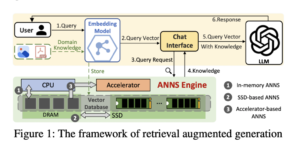
 Approximate nearest neighbor search (ANNS) is a critical technology that powers various AI-driven applications such as data mining, search engines, and recommendation systems. The primary objective of ANNS is to identify the closest vectors to a given query in high-dimensional spaces. This process is essential in contexts where finding similar items quickly is crucial, such […]

 Large language models (LLMs) have revolutionized the field of AI with their ability to generate human-like text and perform complex reasoning. However, despite their capabilities, LLMs need help with tasks requiring domain-specific knowledge, especially in healthcare, law, and finance. When trained on large datasets, these models often miss critical information from specialized domains, leading to […]

 Multimodal models represent a significant advancement in artificial intelligence by enabling systems to process and understand data from multiple sources, like text and images. These models are essential for applications like image captioning, answering visual questions, and assisting in robotics, where understanding visual and language inputs is crucial. With advances in vision-language models (VLMs), AI […]

 Graph sparsification is a fundamental tool in theoretical computer science that helps to reduce the size of a graph without losing key properties. Although many sparsification methods have been introduced, hypergraph separation and cut problems have become highly relevant due to their widespread application and theoretical challenges. Hypergraphs offer more accurate modeling of complex real-world […]